
Mahsoul Shades
Car Parking Shades in Abu Dhabi: Coastal Durability, Approval, and Costs
All guides

Car Parking Shades

Car Parking Shades in Abu Dhabi: Coastal Durability, Approval, and Costs

Abu Dhabi's shading needs split into two very different climate zones: humid, salt-laden air across the capital's island developments — Yas Island, Saadiyat Island, Al Reem Island, and the Corniche — and drier, more intense direct sun further inland around Khalifa City, Musaffah, and Al Ain. A car parking shade built for one zone isn't automatically right for the other, which is why frame protection and foundation planning matter more here than in most other emirates. This guide covers what's genuinely different about specifying a parking shade in Abu Dhabi, alongside the shade types, materials, and cost factors that apply across the capital.

Two climate zones, two sets of priorities

Coastal and island communities — Yas Island, Saadiyat Island, Al Reem Island, Al Bateen, and Al Raha — sit in a humid, salt-laden air environment that accelerates corrosion on untreated or poorly coated steel far faster than inland sites. Frame protection (hot-dip galvanizing, marine-grade aluminium, or a polyurethane topcoat) is a much bigger factor in structure choice here than fabric UV rating alone.

Inland areas — Khalifa City, Mohammed Bin Zayed City, Musaffah, and Al Ain — face less humidity but more sustained direct solar load and larger day-to-night temperature swings, which shifts the priority back toward UV-blocking fabric performance and heat dissipation, similar to inland sites across the rest of the UAE.

Why reclaimed and coastal land changes the engineering

Much of Abu Dhabi's premium waterfront development sits on reclaimed land, which behaves differently under foundation load than natural inland ground. Structures on Yas Island, Saadiyat Island, and Al Reem Island are typically engineered with deeper or wider foundation footings and corrosion-resistant anchor hardware to account for both the soil composition and the sustained salt exposure, rather than using a standard inland foundation spec.

This is one reason Mahsoul Shades' Yas Marina Walkway Roof and Al Reem Penthouse Pergola projects both specified marine-grade aluminium and hot-dip galvanized steel with reinforced anchoring, even though the visible structure above ground looks similar to an inland installation.

Shade types commonly specified in Abu Dhabi

The same core frame configurations used across the UAE apply in Abu Dhabi, with usage patterns skewing toward specific project types:

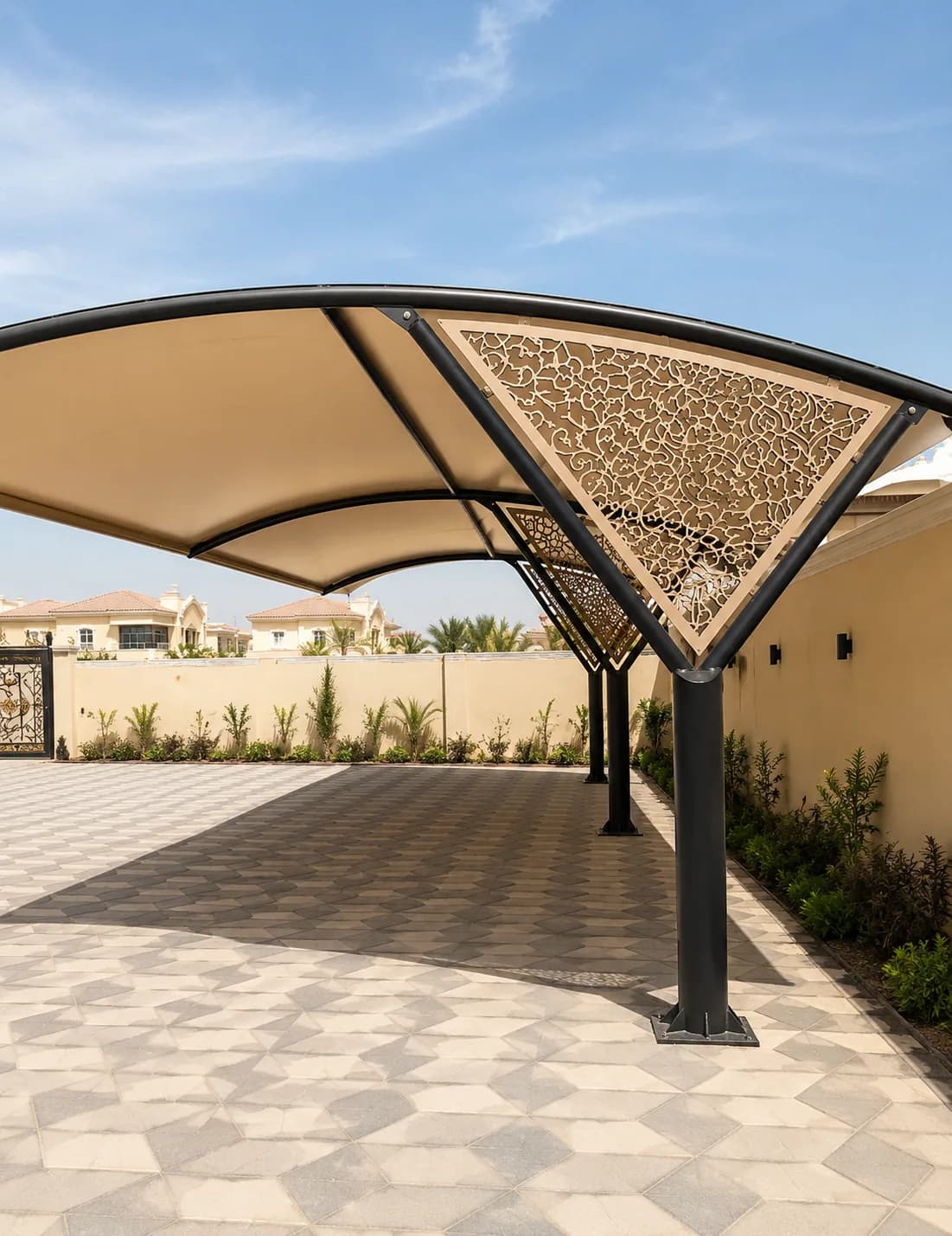
  • Cantilever shades: The default for villa driveways in Khalifa City, Al Raha Gardens, and other residential communities where column-free access matters.
  • Pyramid arch shades: Popular on premium island villas and compounds where the elevated clearance profile helps vent heat in more humid coastal air.
  • Continuous commercial arrays: Used across government facilities, mall parking, and institutional sites, which make up a larger share of Abu Dhabi's commercial parking shade demand than in most other emirates.
  • Tensile membrane structures: Specified for landmark and hospitality projects such as marina walkways, resort pool decks, and waterfront promenades where architectural appearance matters alongside coverage.

Fabric and frame material choices

For coastal and island sites, PVC or PTFE membranes paired with marine-grade aluminium or hot-dip galvanized steel with a polyurethane topcoat are the standard specification, prioritizing corrosion resistance and full waterproofing over the airflow benefits of HDPE mesh. Inland sites in Khalifa City, Musaffah, and Al Ain have more flexibility to use HDPE mesh where budget and airflow are the priority. See our fabric comparison guide for the full trade-offs between HDPE, PVC, and PTFE.

Villa, commercial, and government projects

Villa driveways across Abu Dhabi's residential communities typically need single or double-bay cantilever or pyramid arch shades. Commercial and government sites — mall parking, ADNOC-linked compounds, schools, and public facilities — more often need continuous multi-bay arrays with a higher documentation standard for approval, given the number of government and semi-government stakeholders typically involved in the review.

Approval in Abu Dhabi

Freestanding parking shade structures in Abu Dhabi typically require approval from Abu Dhabi's Department of Municipalities and Transport (DMT), or from the specific community developer's architectural review team for island communities like Yas, Saadiyat, and Al Reem, which often run their own approval layer in addition to (or instead of) municipal review. Confirm which authority applies to your specific site before finalizing a design — our approval process guide covers the general documentation and steps involved.

Cost factors specific to Abu Dhabi sites

Beyond the usual factors of bay count, span, and fabric choice, Abu Dhabi coastal and island sites often carry a cost premium for marine-grade materials and reinforced foundations compared to an equivalent inland structure. Because this varies significantly by exact location and soil conditions, a site assessment gives a far more accurate figure than a generic estimate.

Installation and maintenance considerations

The installation sequence follows the same process used across the UAE — survey, engineering drawings, approval, fabrication, foundation and steelwork, and fabric tensioning — with coastal sites typically needing a longer foundation curing allowance given deeper footings. Once installed, coastal and island structures benefit from more frequent hardware and corrosion checks than inland sites, given the salt-laden air. See our installation process and maintenance guides for the full breakdown.

Areas we serve across Abu Dhabi

Mahsoul Shades installs car parking shades across Yas Island, Saadiyat Island, Al Reem Island, Khalifa City, Al Raha, Al Bateen, Mohammed Bin Zayed City, Musaffah, and Al Ain, alongside our work across Dubai, Sharjah, and the rest of the UAE. The same in-house design, fabrication, and installation team handles every project, backed by 15+ years of experience and 450+ completed projects across all seven emirates.

Frequently Asked Questions

Which authority approves car parking shades in Abu Dhabi?

Abu Dhabi's Department of Municipalities and Transport (DMT) typically handles approval, though island communities such as Yas, Saadiyat, and Al Reem often have their own developer architectural review process as well. Confirm which applies to your specific site before finalizing a design.

Do coastal Abu Dhabi sites need different materials than inland sites?

Yes. Yas Island, Saadiyat Island, Al Reem Island, and other coastal communities benefit from marine-grade aluminium or hot-dip galvanized steel with a polyurethane topcoat and fully waterproof PVC or PTFE fabric, given the salt-laden air. Inland sites like Khalifa City and Al Ain have more flexibility to use HDPE mesh.

Do foundations need to be different on reclaimed island land?

Often yes. Structures on reclaimed land such as Yas Island, Saadiyat Island, and Al Reem Island are typically engineered with deeper or wider foundation footings and corrosion-resistant anchoring compared to a standard inland foundation.

What size car parking shade is standard for an Abu Dhabi villa?

A single-bay shade is typically 6.0m x 3.0m and a double-bay shade around 6.0m x 6.0m, the same standard sizing used across the UAE, adjusted to the specific driveway.

How much does a car parking shade cost in Abu Dhabi?

Cost depends on bay count, span, frame material, fabric, and whether the site needs coastal-grade materials or reinforced foundations. Request a free site assessment for an accurate, itemized quote.

How long does installation take on Abu Dhabi's islands?

A single villa driveway shade typically takes 1 to 2 weeks from approved drawings, though coastal sites with deeper foundations may need a slightly longer curing allowance before steelwork begins.