
Mahsoul Shades
Car Parking Shades in Sharjah: Civic, Cultural, and Industrial Sites
All guides

Car Parking Shades

Car Parking Shades in Sharjah: Civic, Cultural, and Industrial Sites

Sharjah runs two very different parking shade markets side by side: a civic and cultural core — museums, waterfront promenades, government buildings — where architectural appearance carries real weight, and one of the UAE's largest industrial and free zone bases, where wide-span coverage and cost efficiency matter far more than looks. Few emirates ask a shade supplier to move between those two briefs as often as Sharjah does.

A civic and cultural core alongside a major industrial base

Sharjah's identity as the UAE's cultural capital shows up directly in its civic infrastructure — waterfront promenades, museums, and government plazas where a parking or walkway canopy is as much an architectural statement as a functional structure. At the same time, Sharjah Industrial Area, Hamriyah Free Zone, and Sharjah Airport International Free Zone (SAIF Zone) make up one of the largest industrial and free zone bases in the UAE, where the priority flips entirely to wide clear spans, heavy-duty steel, and cost-efficient fabric over any architectural brief.

Very few emirates ask a single shade supplier to move between both of those briefs as regularly as Sharjah does, which is why the right starting question here isn't just "what type of shade" but "which of these two markets is this site actually in."

Case study: a landmark tensile canopy at Al Majaz Waterfront

Mahsoul Shades' Sharjah Cultural Plaza Canopy at Al Majaz Waterfront is a good example of what the civic end of this market demands: a 2,200 sqm sculptural PVDF-coated PTFE membrane suspended on tapered steel masts, engineered through dedicated form-finding software to balance aesthetic gesture with structural efficiency under both desert wind and rare-event rain loads. Translucent panels filter daylight into a soft glow during the day, while concealed up-lighting turns the canopy into a landmark after dark — a self-cleaning PVDF top coat keeps it looking sharp with minimal upkeep, engineered for 150 km/h wind loads with a 25-year membrane warranty.

That level of architectural finish is the exception rather than the rule for Sharjah's industrial sites, where a straightforward galvanized steel and HDPE mesh structure does the job at a fraction of the cost.

Shade types by market segment

The frame configuration that makes sense in Sharjah depends heavily on which segment the site sits in:

  • Tensile membrane canopies: Used for civic, cultural, and waterfront projects like Al Majaz, where appearance and daylight quality matter alongside coverage.
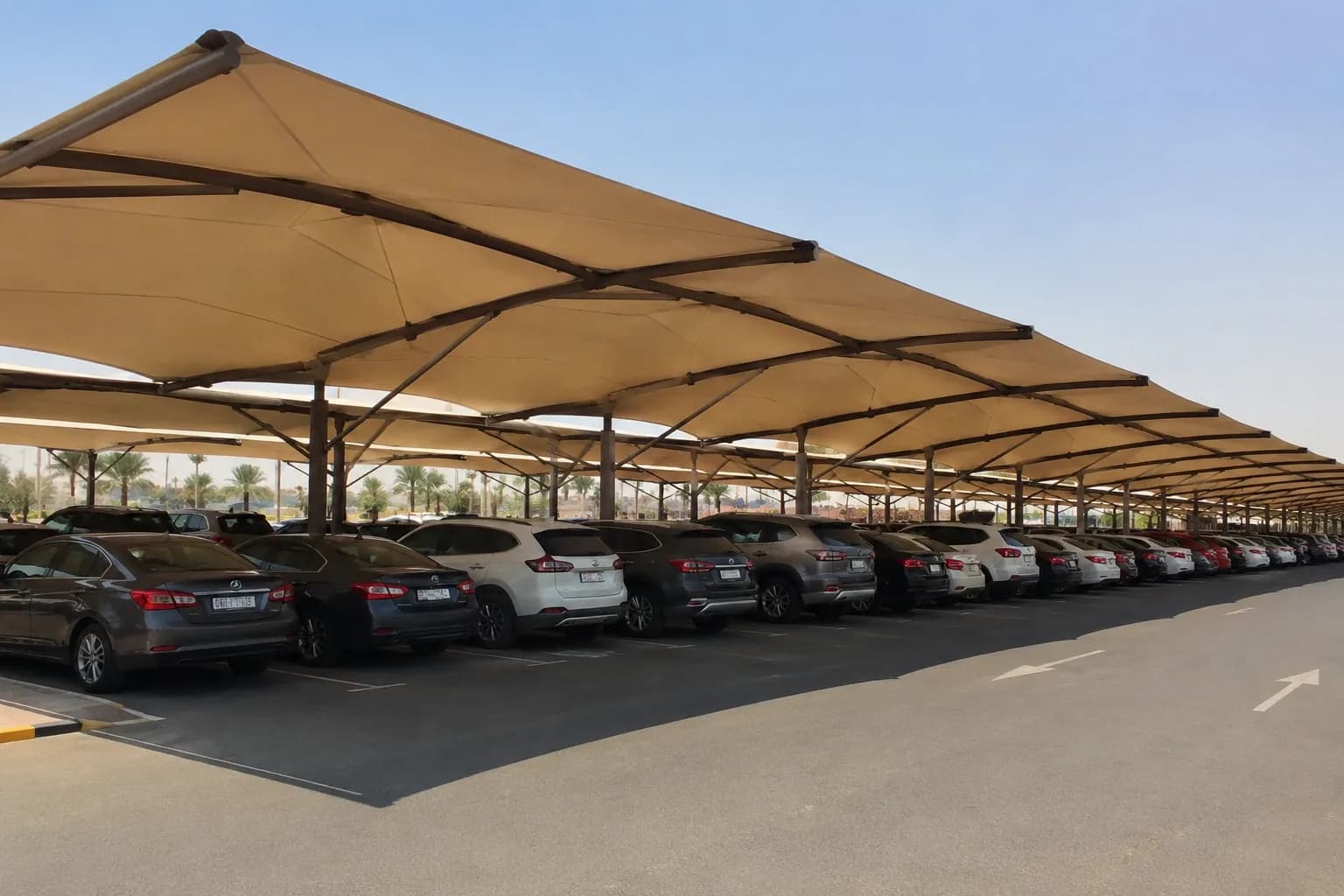
  • Continuous multi-bay arrays: The standard for Sharjah Industrial Area, Hamriyah Free Zone, and SAIF Zone sites, prioritizing wide spans over forklift lanes and staging areas.
  • Cantilever and pyramid arch shades: The default for villa driveways across Sharjah's residential communities, matching the configurations used across the rest of the UAE.

Fabric choices across the two markets

Civic and landmark sites lean toward PTFE fiberglass membrane for its self-cleaning surface, long lifespan, and premium finish, as used on the Al Majaz canopy. Industrial and free zone sites more commonly specify HDPE mesh or standard PVC membrane, prioritizing cost efficiency and airflow over architectural finish. Residential villa sites fall in between, typically using PVC for full waterproofing at a moderate cost. See our fabric comparison guide for the full trade-offs.

Approval in Sharjah

Parking shades on standard municipal land typically require approval through Sharjah Municipality. Sites inside Hamriyah Free Zone or Sharjah Airport International Free Zone (SAIF Zone) instead go through that free zone's own authority, which usually runs a separate review process from the municipality. Civic and government sites often involve an additional design review given their public visibility. Confirm which authority applies to your site before finalizing a design — our approval process guide covers the general documentation involved.

Cost factors specific to Sharjah

Civic and landmark tensile projects carry a premium for PTFE membrane, custom form-finding engineering, and integrated lighting, well above a standard parking shade. Industrial sites generally cost less per square meter than an equivalent Dubai or Abu Dhabi commercial site, given the more standardized specification typical of free zone and logistics facilities. A site assessment gives an accurate figure for either case.

Areas we serve across Sharjah

Mahsoul Shades installs car parking shades and canopies across Al Majaz, Al Khan, Al Nahda, Al Taawun, Muwaileh, and University City, alongside Sharjah Industrial Area, Hamriyah Free Zone, and SAIF Zone, as part of our work across Dubai, Abu Dhabi, and the rest of the UAE.

Frequently Asked Questions

Which authority approves parking shades in Sharjah?

Sharjah Municipality handles approval for standard sites, while Hamriyah Free Zone and SAIF Zone sites go through their own free zone authority instead.

Why did the Sharjah Cultural Plaza Canopy use PTFE instead of PVC or HDPE?

PTFE fiberglass membrane offers a self-cleaning surface, translucent daylight quality, and a 25+ year lifespan, which suited a landmark civic project far better than the shorter lifespan of PVC or HDPE.

Are industrial parking shades in Sharjah cheaper than civic or residential ones?

Generally yes, on a per-square-meter basis, since industrial sites typically specify standard HDPE mesh or PVC over galvanized steel rather than premium architectural membranes.

How much does a car parking shade cost in Sharjah?

Cost depends heavily on which market segment the site falls into — industrial, residential, or civic/landmark — along with bay count, span, and fabric choice. Request a free site assessment for an accurate quote.

Do Sharjah's free zones have separate approval processes?

Yes. Hamriyah Free Zone and SAIF Zone each run their own approval process for structures within their boundaries, separate from Sharjah Municipality's process for standard sites.