
Mahsoul Shades
Car Parking Shades in Dubai: Types, Materials, Cost Factors, and What to Expect
All guides

Car Parking Shades

Car Parking Shades in Dubai: Types, Materials, Cost Factors, and What to Expect

Dubai's summer sun can push an unshaded car's dashboard past 75°C, fade paintwork within a couple of years, and turn a parked vehicle into an oven by midday. A car parking shade is one of the highest-return improvements you can make to a villa, compound, or commercial parking lot in the UAE — but with dozens of suppliers, frame types, and fabric options on the market, most buyers start with the same handful of questions. This guide covers all of them: shade types, materials, cost factors, installation, approval, and maintenance, in the order you'll actually need to think through them.

Why car parking shades matter in Dubai's climate

The UAE combines extremely high UV index, intense direct sun for most of the year, and periodic sandstorms — a combination that accelerates paint fading, dashboard cracking, and interior wear on any vehicle left unshaded. A well-specified shade structure blocks up to 95–98% of UV radiation and can reduce in-cabin temperature by up to 25°C, which translates directly into a cooler, more comfortable start to every drive and a vehicle that holds its resale value longer.

Beyond the vehicle itself, shade structures reduce ambient heat across an entire parking area, which matters for staff and visitor comfort at offices, retail centers, schools, and mosques — anywhere people walk to and from parked cars in peak summer heat.

Types of car parking shades available in Dubai

Most parking shade projects in the UAE use one of the following frame configurations, chosen based on plot shape, bay count, and whether column-free access matters more than cost:

  • Cantilever shades: Supported from a single side or the rear, leaving the front of the bay completely open — the standard choice for villa driveways and tight residential plots where column-free access matters.
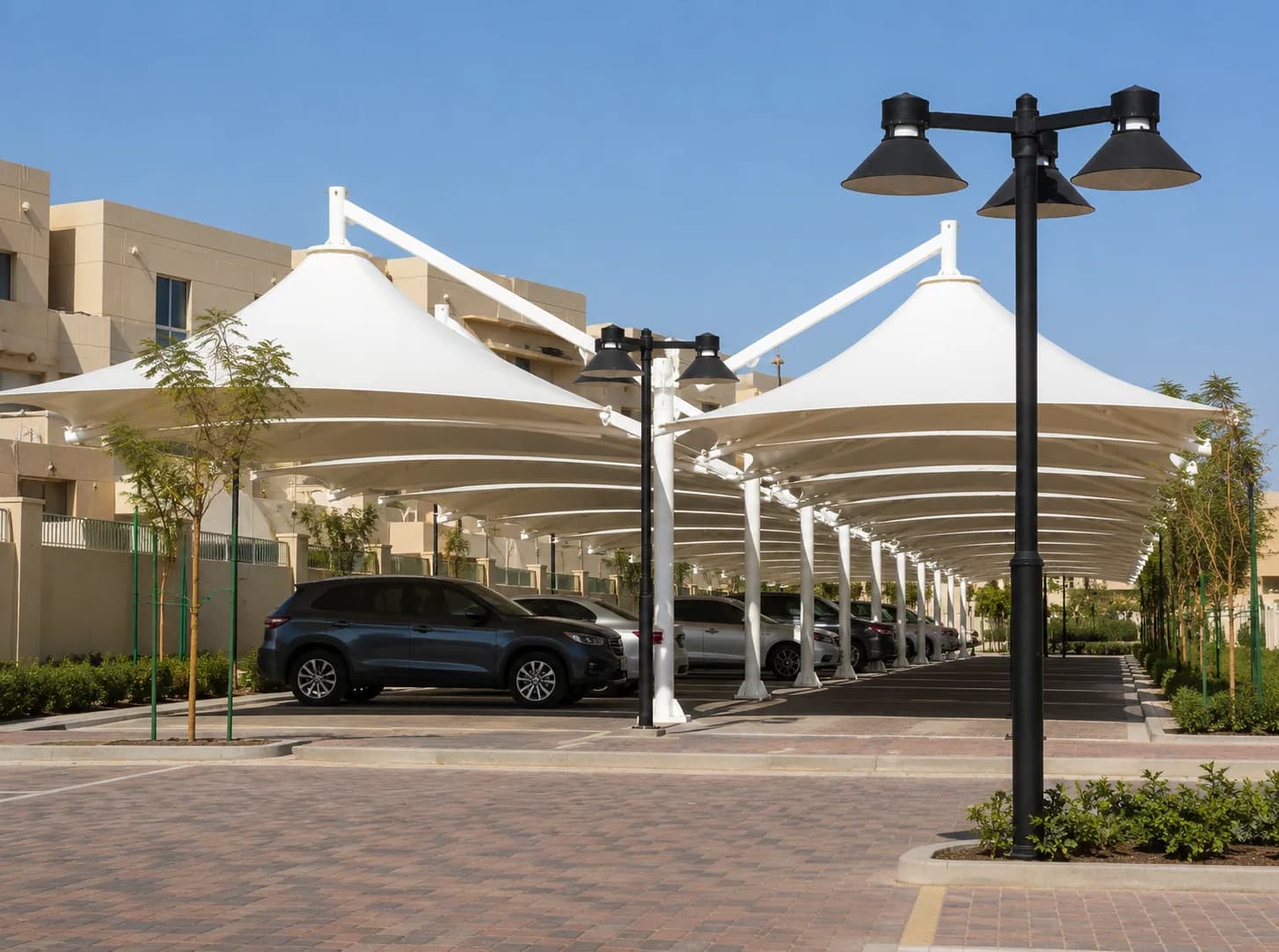
  • Pyramid arch shades: A hybrid pyramid-and-arch profile that lifts hot air away from parked vehicles faster than a flat canopy, popular for premium villas and multi-bay commercial rows.
  • Arch and wave shades: Curved roof profiles that shed rain and sand efficiently while softening the visual bulk of a large multi-bay structure.
  • Central-pole (umbrella) shades: A single central post supports the canopy — economical for individual bays but less practical where every square meter of ground clearance counts.
  • Tensile membrane structures: Stretched fabric over steel and cable supports, used for large-scale commercial lots, malls, and architectural entrances where clear-span coverage and appearance both matter.

Fabric and frame material options

The two decisions that matter most are the roofing fabric and the frame material. HDPE knitted mesh is breathable, blocks up to 95–98% of UV, and is the most budget-friendly option, but it isn't waterproof and typically lasts 8–12 years. PVC and PTFE membranes are fully waterproof, hold up longer (15–20 years for PVC, 25–30+ years for PTFE), and cost more upfront. Framing is almost always hot-dip galvanized or powder-coated structural steel, with aluminium used on lighter pergola-style structures.

Our full fabric comparison guide breaks down HDPE, PVC, and PTFE side by side if you want the detailed trade-offs before deciding.

Villa vs. commercial parking shades

Villa and townhouse driveways typically need single or double-bay cantilever or pyramid arch shades, sized to 1–3 vehicles, with color and post placement matched to the property's façade. Commercial sites — office compounds, retail centers, malls, schools — need continuous multi-bay arrays engineered for higher vehicle turnover, wider spans, and often a specific architectural brief from the developer or facilities team. The engineering process is the same in both cases; the difference is scale and the level of documentation typically required for approval.

Key benefits of installing a car parking shade

  • Reduces in-cabin temperature by up to 25°C and blocks up to 98% of UV radiation
  • Protects paintwork, dashboards, and upholstery from long-term sun damage
  • Improves the visual appearance and perceived value of villas and commercial properties
  • Keeps parking areas usable and comfortable for staff and visitors through peak summer
  • Column-free layouts (cantilever, pyramid arch) improve vehicle maneuvering and reduce bumper damage

What determines the cost of a car parking shade in Dubai

Pricing depends on bay count and span, frame material (steel vs. aluminium), fabric choice (HDPE, PVC, or PTFE), foundation depth, and site access. A single-bay villa shade sits at a very different price point than a multi-bay commercial array, and coastal or high-wind sites require heavier steel and deeper foundations that add to cost. Rather than quote a generic figure that won't reflect your specific site, we recommend a free site assessment — it takes a few minutes and gives you an accurate, itemized quote instead of a rough estimate.

The installation process, start to finish

Every project follows the same sequence: site survey and concept layout, structural drawings and wind-load calculations, municipality or community approval where required, in-house fabrication, foundation and steelwork, and fabric tensioning and handover. A single villa driveway shade typically takes 1–2 weeks from approved drawings; larger commercial arrays take longer depending on scale. See our full installation process guide for what to expect at each stage.

Do you need approval for a car parking shade in Dubai?

In most cases, yes — freestanding parking shades are permanent structures with foundations, so municipality or community authority approval is typically required before installation. Requirements vary by emirate and by whether the site sits inside a gated community, so it's worth reading our approval process guide or letting us handle the submission directly.

Wind resistance and durability

The UAE's seasonal winds and sandstorms make wind load rating one of the most important specs on a parking shade. Standard cantilever and pyramid arch structures from Mahsoul Shades are rated up to 160 km/hr, with heavier specifications available for coastal or elevated sites. Our wind load ratings guide explains how these ratings are calculated and what's typical for each structure type.

Maintaining your car parking shade

A parking shade needs very little upkeep, but a periodic check goes a long way: inspect fabric tension and hardware every few months, clean fabric with a soft brush and mild soap, and re-tension after any severe wind event. See our maintenance guide for a full seasonal checklist.

Areas we serve across Dubai and the UAE

Mahsoul Shades installs car parking shades across Dubai — including villa communities, business districts, and industrial zones — as well as Abu Dhabi, Sharjah, Ajman, Ras Al Khaimah, Umm Al Quwain, and Fujairah. Whether it's a single villa driveway or a multi-bay commercial array, the same in-house design, fabrication, and installation team handles the project end to end, backed by 15+ years of experience and 450+ completed projects across all seven emirates.

Frequently Asked Questions

What is the standard size of a car parking shade?

A single-bay shade is typically sized around 6.0m x 3.0m, and a double-bay shade around 6.0m x 6.0m. Commercial arrays are custom-sized to the bay count and site width.

Which is better for Dubai, HDPE or PVC car parking shades?

HDPE mesh suits sites where airflow and cost matter most, since it blocks up to 98% of UV but is water-permeable. PVC membrane is fully waterproof and longer-lasting, making it the better choice where rain protection is also a priority.

How long does a car parking shade last?

The steel frame typically lasts 20+ years with proper coating maintenance. Fabric lifespan depends on material: 8–12 years for HDPE mesh, 15–20 years for PVC, and 25–30+ years for PTFE.

Are car parking shades waterproof?

PVC and PTFE membranes are fully waterproof. HDPE knitted mesh is breathable and water-permeable, so it reduces rain exposure but does not fully seal it out.

How long does installation take?

A single villa driveway installation typically takes 1 to 2 weeks from approved drawings, while larger commercial parking arrays can take several weeks depending on scale and site access.

Do I need approval before installing a car parking shade?

Most freestanding parking shades require approval from the relevant municipality or community authority before installation. We supply the structural drawings and documentation needed for submission.

How much does a car parking shade cost in Dubai?

Cost depends on bay count, span, frame material, and fabric choice, so it's best assessed per site rather than quoted generically. Request a free site assessment for an accurate, itemized quote.

Can car parking shades be customized to match my property?

Yes. Frame color, fabric color, and roof profile (cantilever, pyramid arch, arch, or wave) can all be matched to your villa's façade or a commercial development's design guidelines.